
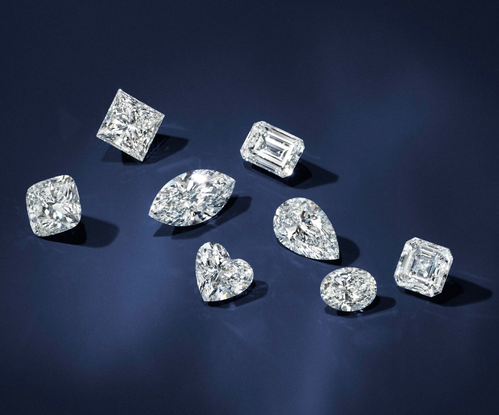
What is a Diamond?
Over a billion years ago, deep beneath the Earth’s surface, carbon atoms bonded tightly under high temperatures and extreme pressure, resulting in the world’s hardest natural mineral: diamond.
Hidden for millions of years, diamonds only reached the Earth’s surface after volcanic activity transported them upward in magma. Then, in the 4th Century BC, the first diamonds were found in India. Today, as they have been for centuries, diamonds are one of the most beautiful and coveted objects on Earth.
Types of Diamonds
Natural Diamonds
Natural diamonds form deep within the Earth under extreme conditions of heat and pressure. They are comprised of nearly 99.95% carbon, with the other 0.05% reflecting trace elements that aren’t part of their essential chemistry — making diamond the only gemstone constructed of a single element. They are the hardest naturally occurring material found on Earth and one of the most sought-after.
Lab Diamonds
Lab diamonds are optically, chemically, and physically the same as natural diamonds. In other words, they look, feel, and are identical. Their difference lies only in their origins — natural diamonds form within the Earth, and lab diamonds are grown by professionals with specialized equipment. Another difference relates to cost; as lab grown diamonds are less rare than natural diamonds, they often come at a much more accessible price.